

Growth and Development
Flax is an annual plant that grows to a height of 40 to 91 cm (16 to 36 in.), depending on variety, plant density, soil fertility, temperature and available moisture. Flax is highly self-pollinating, with outcrossing rates from 0.3 to 2.0% under normal circumstances. Insects are the primary agents of outcrossing.
The life cycle of the flax plant consists of a 45- to 60-day vegetative period; a 15- to 25-day flowering period; and a maturation period of 30 to 40 days. Although there is a period of intense flowering, a small number of flowers may continue to appear right up to maturity. Maturity is delayed under cool, wet conditions. The crop lifecycle from seeding to maturity is typically 90 to 125 days, depending on overall environmental conditions. Drought, high temperature and disease can shorten the growth period and crop lifecycle. If ripening occurs under high soil moisture and fertility conditions, stems may remain green and new growth may result in a second period of intense flowering. Maturity will be delayed under cooler than normal growing conditions, at higher altitudes characterized by lower heat units (i.e. western Alberta and Peace River region), or in the northern prairies. Under these conditions, the lifecycle may be extended to over 125 days.
Growth Stages
There are 12 distinct growth stages (GS) in the development of a flax plant (see Fig. 1). In the illustration below, these GS’s are shown as numbered line drawings. Each illustration has a title description and, in some cases, additional identifying information. These growth stages also correspond to the growth stages referred to in the diagnostic guide.
After germination, the cotyledons (two small seed leaves) emerge in stage 1 and the young seedling proceeds to first true leaf formation in stage 2. After this, a second pair of leaves (stage 3) are unfolded, then the third pair of true leaves (stage 4), and so on to more leaves and stem extension (stage 5). The flax plant has one main stem, but two or more branches (tillers) may develop from the base of the plant when plant density is low and/or high soil nitrogen levels. Basal branching is also prominent if the main stem of a young seedling is damaged (loss of apical dominance). Canadian flax varieties vary with regards to basal branching, from limited to extensive. The main stem continues to extend and buds form at the top of the plant (stage 6). In stage 7, early branching of the main stem becomes obvious towards the top of the plant, at about 30 cm up (12 in.). Around this time, the first flower will begin to open. The main stem and branches give rise to a multi-branched, irregular arrangement of flowers. The plant has a short, branched taproot which may extend to a depth of more than 1 m (39 in.) with side branches stretching approximately 30 cm (12 in.). Compared with other major crops of the prairies, flax has a relatively limited root system (shallow with limited root volume).
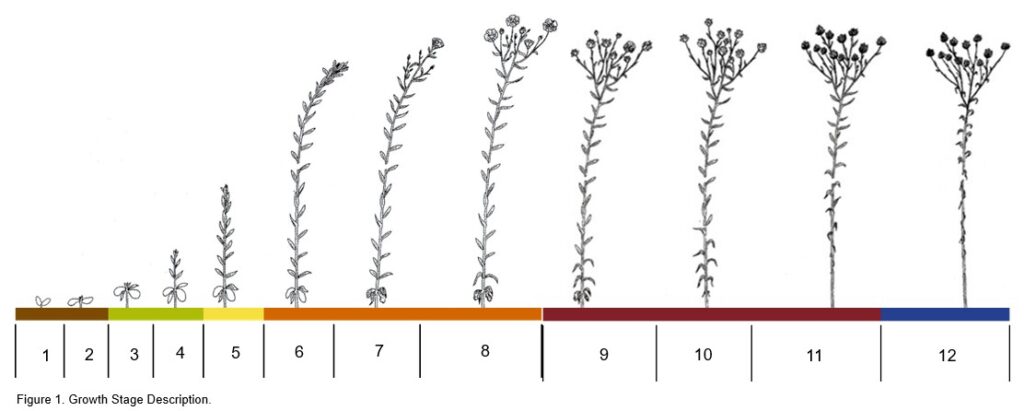
- cotyledon
- growing point emerged
- first pair of true leaves unfolded
- third pair of true leaves unfolded, start of leaf spiral
- stem extension
- buds visible
- first flower, early branching
- full flower, capsules start forming, continuation of branching
9. late flower, most branches and capsules formed
10. green capsule, seed white, lower leaves yellow
11. brown capsule, seeds light brown (or otherwise pigmented) plump and pliable–maximum dry matter branches, stem and upper leaves green/yellow middle leaves partly senescent and lower leaves shriveled or dropped
12. seed ripe, seeds brown (or otherwise pigmented) and rattle in capsules, branches and upper leaves senescent but stem still green/yellow
Seeds
Flax seeds are flat, oval and are pointed at one end. A thousand seeds weigh from about 5 to 7 g (less than 1 oz.), depending on variety and growing conditions. Canadian flax varieties range in colour from light brown to dark reddish brown or yellow. Mottled seed, a combination of yellow and brown on the same seed, may be the result of environmental conditions.
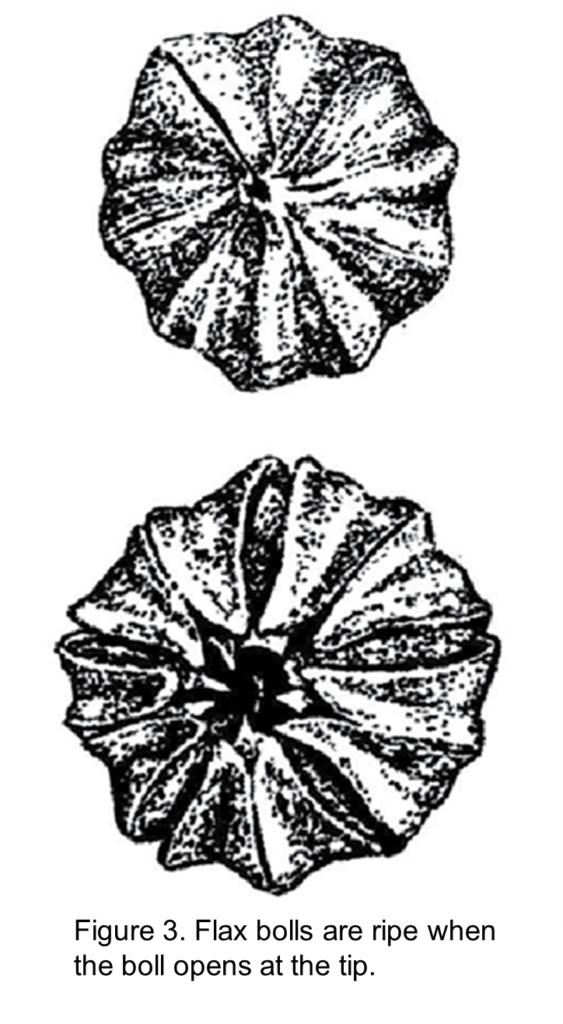
The seed is covered with a coating (mucilage) that gives it a high shine and causes the seed to become sticky when wet. At times, this mucilage absorbs moisture from the air, causing the mature seeds to stick to the boll surface. This removes the shine on the seeds, giving them a scabby appearance which may result in a reduced grade.

