

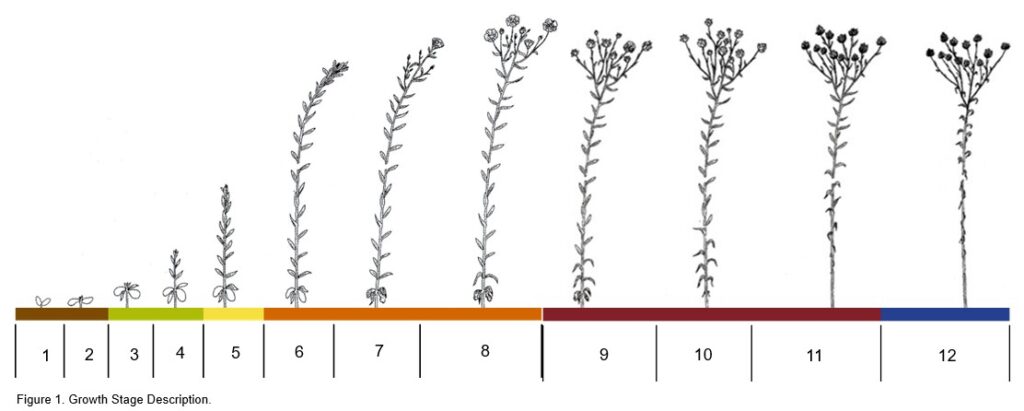
Growth Stages 1 & 2: Pre-Emergence to Emergence
| What to look for | What to do | |
| Regular Pattern- | ||
| Seeder problems | Next time: Maintain seeder & check often for plugged runs; make sure shovels, knives & discs are levelled before seeding | |
| Irregular Pattern or Patches- | Do not find seed | |
| Low seeding rate | Next time: Use suggested seeding rate for local growing conditions | |
| Deep seeding | Next time: Use suggested seeding depth and rate for local growing conditions | |
| Wireworms | See Flax Field Management – Insect Pests | |
| Cutworms | Now: Apply recommended insecticide if >4-5/m²; determine if infestation is limited to patches or over entire field See Flax Field Management – Insect Pests | |
| Irregular Pattern or Patches- | Find adequate seed + evidence of insect activity | |
| Wireworms | See Flax Field Management – Insect Pests | |
| Cutworms | Now: Apply recommended insecticide if >4-5/m² See Flax Field Management – Insect Pests | |
| Irregular Pattern or Patches– | Find adequate seed + no evidence of insect activity; Adequate germination; Normal Seedlings | |
| Cold soil | Next time: Plant later, especially in a cold spring; use treated seed | |
| Deep seeding | Next time: Plant at 2.5-4 cm (1-1.5 inches) deep into firm moist soil | |
| Soil crusting | Now: Use harrow or packer bar to break up crust. Next time: Leave more crop residue on soil surface; adopt zero-till to build soil organic matter long-term; avoid soils that curst easily; if irrigation is available, sprinkle to soften crust | |
| Untreated seed | Next time: Buy certified seed; if you use farm-produced seed, slow down combine cylinder and/or open concave to reduce cracking | |
| Seeding implement did not clear field trash properly | Next time: do a more thorough job of spreading and chopping trash from previous crop | |
| Irregular Pattern or Patches- | Find adequate seed + no evidence of insect activity; Adequate germination; Abnormal seedlings | |
| Cracked or poor-quality seed | Next time: Buy certified seed; if you use farm-produced seed, slow down combine cylinder and/or open concave to reduce cracking | |
| Irregular Pattern or Patches- | Find adequate seed + no evidence of insect activity; Poor Germination; Pre-emergent herbicide | |
| Trifluralin damage | Next time: Apply trifluralin in fall only; Plant certified seed, shallow into firm, moist seedbed | |
| Irregular Pattern or Patches- | Find adequate seed + no evidence of insect activity; Poor Germination; No pre-emergent herbicide | |
| Herbicide residues | Next time: Check previous year’s herbicide for residual characteristics | |
| Irregular Pattern or Patches- | Find adequate seed + no evidence of insect activity; Poor Germination; No pre-emergent herbicide; Adequate Moisture | |
| Poor seed quality | Next time: Buy certified seed | |
| Fertilizer burn | Next time: Band some or all fertilizer away from seed | |
| Treated seed stored too long | Next time: Treat seed as needed | |
| Saline soils | Now: Provide proper fertility levels Next time: Use soil tests to choose land that is suitable for flax | |
| Find adequate seed + no evidence of insect activity; Poor Germination; No pre-emergent herbicide; Low moisture | ||
| Too much spring tillage | Now: Use a packer to improve the seedbed Next time: Apply trifluralin and/or fertilizer in the fall; Avoid sandy land | |
| Loose, unpacked soil | Now: Pack the soil Next time: Pack the soil; Adopt zero-till seeding | |
| Treated seed stored too long | Next time: Treat seed as needed |
Growth Stages 3 & 4: Seedling
| What to look for: | What to do: | |
| General or uniform gradient or pattern- | ||
| Chlorosis | Next time: Plant more tolerant varieties | |
| Herbicide injury: Typical result of herbicide application | Next time: Separate grass and broadleaf weed control under hot, humid conditions | |
| Herbicide injury: Stressful environmental conditions | Now: Spray in the evening or very early in the morning, or wait until stressful conditions pass Next time: Spray in the evening or very early in the morning, or wait until stressful conditions pass | |
| Irregular patterns or patches- | ||
| Wet or saturated soils | Now: Improve drainage on the field Next time: Improve drainage on the field; Plant crops that improve the water infiltration capacity of the soil; Adopt zero-till | |
| Nutrient deficiency | Now: See Environmental Disorders; Improve drainage on the field; Do a plant tissue analysis test; use a comparative soil plus tissue test from a good area in the field to a soil plus tissue test from a poor area within the same field Next time: See Environmental Disorders; Improve drainage on the field | |
| Seedling blight & root rot | Next time: Use treated, uncracked seed; Use seeder with on-row packing; Follow at least a three-year flax rotation; Avoid legumes or sugar beets as previous crops; For breakdown of quackgrass patches, spray in the fall |
| What to look for: | What to do: |
| Cutworms | Now: Apply recommended insecticide if >4-5/m²; see Flax Field Management – Insect Pests |
| Heat canker | Next time: Plant earlier at a high seeding rate |
| Frost damage | Next time: Plant late to avoid spring frost |
| Fusarium wilt | Next time: Plant resistant varieties; Practice recommended crop rotations |
| What to look for: | What to do: | |
| Cold, wet weather | ||
| Herbicide injury | ||
| Bromoxynil/MCPA | Next time: See Environmental Disorders; Separate grass and broadleaf weed control under hot, humid conditions | |
| Inappropriate rates of pre-emergent herbicides for soil type | Next time: Read and follow label precautions; Check levels of soil organic matter | |
| Flax plants pre-sensitized from pre-emergent herbicide | Next time: Use post-emergent herbicides cautiously, especially under stressful environmental conditions (e.g. cold and wet soils) | |
| Fertilizer burn (especially in dry soil conditions) | Next time: Follow the guidelines for safe rates of fertilizer applied with the seed; Apply low level of starter fertilizer with the seed and band the rest of the fertilizer in side or mid-row bands | |
| Aster yellow disease and crinkle disease | Next time: See Flax Field Management – Disease Control; Seed early to avoid migrating leafhoppers |
| What to look for: | What to do: |
| Quackgrass | Now: Apply a post-emergent graminicide (e.g. clethodim, Poast Ultra, quizalofop); Apply a pre-harvest treatment (e.g. glyphosate) Next time: Apply pre-harvest or post-harvest treatment (e.g. glyphosate) to the previous crop (if registered on that crop) |
| Wild Oats & Volunteer Cereals | Now: Apply a post-emergent graminicide (e.g. clethodim, Poast Ultra, quizalofop) Next time: In areas where it is recommended, use fall tillage to encourage germination of volunteers; Apply a pre-emergent herbicide (e.g. Avadex, Eptam 8-E, trifluralin, or Fortress); Use spring tillage to destroy the first flush of weeds and volunteers |
| Annual Broadleaf Weeds (no or few thistles or dandelions) | Now: Apply a post-emergent herbicide (e.g. Basagran, Basagran Forte, bromoxynil and/or MCPA); Check the crop 5-10 days after spraying for regrowth of weeds; re-spray if necessary Next time: Apply a pre-emergent herbicide (e.g. Authority, trifluralin, Eptam 8-E, Fortress) |
| Canada Thistle & Sow Thistle | Now: Apply a post-emergent herbicide (e.g. Basagran, bromoxynil/MCPA, Curtail M, Lontrel, MCPA); Apply a pre-harvest, post-harvest treatment (e.g. glyphosate); Check the crop 5-10 days after spraying for regrowth of weeds; re-spray if necessary Next time: Apply pre-harvest or post-harvest treatment (e.g. glyphosate) to the previous crop (if registered on that crop) |
| Other Perennials (e.g. Toadflax, dandelion) | Now: Apply a pre-harvest, post-harvest treatment (e.g. glyphosate) Next time: Apply pre-harvest or post-harvest treatment (e.g. glyphosate) to the previous crop (if registered on that crop) |
| All Weeds | Next time: Use a higher seeding rate and/or a seeding implement with a narrower row spacing and/or wider seed spread pattern to increase in-crop competition for late emerging weeds |
| What to look for: | What to do: | |
| Stressful environmental conditions- | ||
| extreme temperatures (hot or cold) | Next time: Read & follow label cautions relating to environmental conditions | |
| drought | Next time: Read & follow label cautions relating to environmental conditions | |
| Rain too soon after herbicide application | Now: Wait to see if control symptoms appear before respraying Next time: Spray only when rain not imminent | |
| Incorrect application rate | Next time: Read & follow label cautions, especially under stressful environmental conditions | |
| Incorrect water volumes | Next time: Use recommended water volume & pressure, especially with contact herbicides | |
| Surfactant not added as needed | Next time: Use all recommended components of a herbicide for maximum efficacy | |
| Inadequate soil incorporation of pre-emergent herbicides- | ||
| incorporation delayed too long after application | Next time: Incorporate according to manufacturers’ directions | |
| incorrect incorporation depth | Next time: Incorporate according to manufacturers’ directions | |
| incorrect number or direction of incorporation passes | Next time: Incorporate according to manufacturers’ directions | |
| Antagonistic herbicide tank mix | Next time: Use only registered tank mixes | |
| Incorrect weed stage | Next time: Identify weeds, then read & follow label directions for leaf stages for each weed | |
| Not enough days between two herbicide applications | Next time: Allow recommended number of days between non-tankmixable herbicides | |
| Resistance of weeds to a herbicide or herbicide group | Next time: Rotate between herbicide groups (see provincial guides); Use integrated weed-control strategies (cultural, biological, physical, chemical control) | |
| Unsuitable water used to mix with herbicides | Next time: Use water known to produce good results when mixed with herbicides | |
| Not enough in-crop competition from flax | Next time: Use a higher seeding rate and/or a seeding implement with narrower row spacing and/or wider seed spread pattern to increase in-crop competition for late emerging weeds. |
Weed Control Options for Flax
| Right Now | Next Time Around | |||||
| Weed | Action | Crop Stage | Weed Stage | Action | Crop Stage | Weed Stage |
| Quackgrass | Quizalofop | 82 days* | 2-6 leaf | Glyphosate | pre-harvest | 4-5 green leaf |
| Poast Ultra | 60 days* | 1-3 leaf | post-harvest | 3-4 actively growing leaf | ||
| Clethodim | 60 days* | 2-6 leaf | pre-plant | 3-4 actively growing leaf | ||
| Wild oats, green & yellow foxtail, volunteer cereals | Quizalofop | 82 days* | 2 – early tillering | Fall Tillage | post-harvest | post-emergent |
| Poast Ultra | 60 days* | 1-6 leaf (GF,YF); 1-4 leaf (WO, vol. cereals) | Spring Tillage | pre-plant | post-emergent | |
| Clethodim | 60 days* | 2-6 leaf | Glyphosate | pre-plant | post-emergent | |
| Eptam 8-E (not in SK) | spring or fall pre-plant | pre-emergent | ||||
| Wild oats, green & yellow foxtail | Trifluralin | pre-plant | pre-emergent | |||
| Fortress | pre-plant | pre-emergent | ||||
| Wild oats only | Avadex | spring or fall pre-plant | pre-emergent | |||
| Annual broadleaf weeds – lamb’s quarters, redroot pigweed, smartweed, wild mustard, russian thistle | Basagran/Basagran Forte | >5 cm (>2 in.) | See herbicide label | Authority | pre-plant (spring only) | pre-emergent (LQ, pigweed only) |
| Bromoxynil | 5-10 cm (2-4 in.) | 1-4 leaf; 1-8 leaf (LQ) | Glyphosate | pre-plant | post-emergent | |
| Bromoxynil/MCPA | 5 cm (2 in.) to early bud, 5-10 cm (2-4 in.) best | <4 leaf; <8 leaf (LQ, W. Must.) | Trifluralin | pre-plant (fall only) | pre-emergent (LQ, pigweed, R. thistle only) | |
| Curtail M | 5-15 cm (2-6 in.) | 1-4 leaf (not R. thistle) | Eptam 8-E (not in SK) | pre-plant | pre-emergent (LQ, pigweed only) | |
| MCPA | 5 cm (2 in.) to prebud, 5-10 cm (2-4 in.) best | 2-4 leaf (LQ, W. Must. only) | Fortress | pre-plant fall or spring | pre-emergent (suppress LQ, R. thistle, pigweed only) | |
| Annual broadleaf weeds – kochia, wild buckwheat | Bromoxynil | 5-10 cm (2-4 in.) | 1-4 leaf (kochia); 1-8 leaf (W. buckwheat) | Authority | pre-plant (spring only) | pre-emergent |
| Bromoxynil/MCPA | 5 cm (2 in.) to early bud, 5-10 cm (2-4 in.) best | <4 leaf (kochia); <8 leaf (W. buckwheat) | Fortress | fall or spring pre-plant | pre-emergent | |
| Curtail M | 5-15 cm (2-6 in.) | 1-4 leaf (W. buckwheat only) | Glyphosate | pre-plant | pre-emergent (W. buckwheat only) | |
| Lontrel 360 | 5-10 cm (2-4 in.) | young & actively growing (W. buckwheat only) | Trifluralin | pre-plant (fall only) | pre-emergent (W. buckwheat only) | |
| Canada Thistle | Basagran/Basagran Forte | >5 cm (>2 in.) | 15-20 cm (6-8 in.) | Glyphosate | pre-harvest | bud & beyond |
| Bromoxynil/MCPA | 5 cm (2 in.) to early bud, 5-10 cm (2-4 in.) best | top growth | post-harvest | 20-25 cm (8-10 in.) or actively growing | ||
| Curtail M | 5-15 cm (2-6 in.) | 1-4 leaf | ||||
| Lontrel 360 | 5-10 cm (2-4 in.) | rosette to prebud | ||||
| MCPA/MCPA K | 5 cm (2 in.) to early bud, 5-10 cm (2-4 in.) best | 2-4 leaf |
*pre-harvest interval, CAUTION! Always read and follow label directions.
Growth Stage 5: Steam Extension & Tillering
| What to look for: | What to do: | |
| Leaf Feeding- | ||
| Bertha armyworm | Now: Monitor the problem and spray with a recommended insecticide if feeding is extensive or before boll feeding begins | |
| Army cutworm | Now: Monitor the problem and spray with a recommended insecticide when larvae populations reach 4-5/m² | |
| Zebra caterpillar | Now: Not normally a significant problem in flax | |
| Leaf Spots- | Rust | Next time: Practice recommended crop rotations; Use rust-resistant varieties |
| Leaf Loss- | Pasmo disease | Next time: Use treated seed early at recommended rates; Use lodge-resistant varieties; Control Weeds; Practice recommended crop rotations; Foliar application of fungicide at early flowering |
| Deformed or Puckered Leaves- | ||
| Crinkle | See Flax Field Management – Disease Control | |
| Aster yellows | Next time: Plant as early as possible to reduce incidence and severity of the disease; See Flax Field Management – Disease Control | |
| Reduced Tillering- | ||
| Crinkle | See Flax Field Management – Disease Control | |
| Too heavy seeding rate & plant stand | Next time: Plant at recommended seeding rate for local soil type & moisture conditions; See Flax Seeding | |
| Bending Stem (S-Shape)- | Herbicide injury from MCPA, especially in hot, humid weather | Next time: Delay application of MCPA to evening or early morning if hot conditions persist |
Growth Stages 6-8: Top Branching, Bud Formation & Early Flowering
| What to look for: | What to do: | |
| Lodging- | Flax Field Management | |
| Too heavy seeding rate & plant stand | Next time: Plant varieties more tolerant to lodging; Plant at recommended seeding rate for local soil type & moisture conditions | |
| Too much nitrogen | Next time: Soil test & apply fertilizer according to realistic yield target | |
| Root rot | Next time: Practice recommended crop rotations; Use a recommended seed treatment; Avoid legumes or sugar beets as previous crops; See Flax Field Management – Disease Control | |
| Stem break & browing disease | Next time: Use disease-free, certified seed; Use a recommended seed treatment; Practice recommended crop rotations | |
| Reduced Flowering of No Flowers- | ||
| Lygus bug damage to growing tips of plants | Now: Monitor with a sweep net; Economic thresholds not developed; See Flax Field Management – Pest Control | |
| Dieback of terminal buds – soil too high in lime | Next time: Soil test & add nutrients to correct the imbalance in the soil | |
| Dieback of terminal buds – wet or saturated soils | Now: Improve surface drainage on the field Next time: Practice recommended crop rotation for local soils | |
| Dieback of terminal buds – chlorosis | Next time: Practice recommended crop rotation for local soils; Use chlorosis resistant varieties | |
| Excessive Branching from Lower Stems- | ||
| Wet or saturated soils | Now: Improve surface drainage on the field Next time: Practice recommended crop rotation for local soils | |
| Low plant density | Next time: Use suggested seeding rate for local growing conditions |
Growth Stages 9, 10 & 11: Flowering & Boll Formation
| What to look for: | What to do: | |
| Eggs in Flowers- | Flax bollworm | Now: Economic infestations not common; See Flax Field Management – Pest Control |
| Small Green Insects on Stems & Leaves- | Aphids | Now: Apply a recommended insecticide if 3 or more aphids are found on a steam at full flower, or 8 or more at green boll stage; See Flax Field Management – Pest Control *Note: Juvenile Lygus bugs are also small green insects but are very active compared to aphids |
| Deformed Flowers- | Aster yellows | Next time: Seed as early as possible to avoid migrating leafhoppers in mid to late season; See Flax Field Management – Pest Control |
| Holes in Boll- | Flax bollworm | Now: Economic infestations not common; See Flax Field Management – Pest Control |
| Bolls Missing- | ||
| Grasshoppers | Now: Apply a recommended insecticide when populations exceed 2/m²; See Flax Field Management – Pest Control Next time: Plant trap crop around field *Note: Bertha armyworm can also clip bolls in flax | |
| Pasmo disease along with strong winds & rain | Next time: Practice recommended crop rotations; See Flax Field Management – Disease Control | |
| Premature Ripening- | Pasmo disease | Next time: Practice recommended crop rotations; See Flax Field Management – Disease Control |
| Dead Plants in Patches Especially in Lodged Areas- | Pasmo disease | Next time: Practice recommended crop rotations; See Flax Field Management – Disease Control |
| Wilted Plants Especially on Warm Days- | Root rot | Next time: Practice recommended crop rotations; See Flax Field Management – Disease Control |
Growth Stage 12: Maturity
| What to look for: | What to do: | |
| Low Yields- | ||
| Low soil phosphorous levels | Next time: Soil test to determine P level; Apply safe rate of phosphate with the seed and side or mid-row band any additional amounts needed; Apply additional phosphorous to the crop previous to flax | |
| Low nitrogen levels | Next Time: Soil test & apply fertilizer according to a realistic yield target | |
| Desiccated crop too early | Next time: Apply desiccant when 75% of bolls have turned brown | |
| Root rot | Next time: Use treated, uncracked seed; Use seeder with on-row packing; Follow at least a 3-year flax rotation; Avoid legumes or sugar beets as previous crops; See Flax Field Management – Disease Control | |
| Late planted crop | Next time: Do some or all seedbed preparation in the fall prior; Seed earlier, if possible | |
| Toxic Effects from Canola/Mustard Stubble Especially in Unspread Swath | Next time: Use a chaff spreader & a fine-cut straw chopper on the combine; Practice recommended crop rotations; Do not seed flax on canola/mustard stubble | |
| Bolls Missing or Scattered on Ground- | High winds | Next time: Plant varieties more tolerant to boll drop; Harvest the crop at the appropriate stage of maturity, especially if a desiccant has been used |
| Low Bushel Weight- | Desiccated crop too early | Next time: Apply desiccant when 75% of bolls have turned brown |
| Swath Blows Easily- | Crop cut too low | Next time: Leave 10-15 cm (4-6 in.) of stubble; Straight harvest flax; Consider use of a swath roller |
| Swath Takes a Long Time to Dry- | Crop cut too low | Next time: Leave 10-15 cm (4-6 in.) of stubble to keep swath off ground & facilitate drying |
| Swather Gums Up- | Cutting knives too old & dull | Now: Replace cutting knives Next time: Replace worn cutting knives; If knives are OK, lubricate the cutting bar with light oil |
| Delayed Maturity- | ||
| Herbicide injury from MCPA, Bromoxynil | Next time: Read & follow label cautions relating especially to environmental conditions; Plant earlier maturing varieties | |
| Excess nitrogen | Next time: Soil test & apply fertilizer according to a realistic yield target | |
| Cracked or Damaged Seed- | ||
| Combine cylinder speed too high | Now: Reduce cylinder speed Next time: Reduce cylinder speed | |
| Combine concave set too tight | Now: Increase concave clearance Next time: Increase concave clearance *Note: Refer to owners’ manual to determine the correct course of action for changing combine settings | |
| Seed too dry | Now: Adjust combine during day to adjust for changes in temperatures and humidity Next time: Adjust combine during day to adjust for changes in temperatures and humidity | |
| High Dockage- | ||
| Uncontrolled weeds in the field | Next time: Recheck fields for weeds after control measures have been taken; Increase crop competition by increasing seeding rate and/or decreasing row spacing and/or increasing the seed spread in the row | |
| Volunteer crops in field | Next time: In areas where suitable, use previous fall tillage to encourage volunteers to grow; Control crops with suitable herbicides; Increase crop competition by increasing seeding rate and/or decreasing row spacing and/or increasing the seed spread in the row | |
| Broken seeds in sample | Now: Slow down combine cylinder speed, open cylinder, open bottom sieve Next time: Slow down combine cylinder speed, open cylinder, open bottom sieve | |
| Earth pellets | Now: Raise the combine pickup Next time: Leave 10-15 cm (4-6 in.) of stubble to keep swath off ground; Raise the combine pickup | |
| Excess dockage in hopper | Now: Close bottom sieve Next time: Close bottom sieve | |
| Excess dockage in hopper & low shoe loss out of rear combine | Now: Increase fan speed Next time: Increase fan speed | |
| Low Grade- | ||
| Low test weight | Now: Increase combine fan speed Next time: Leave 10-15 cm (4-6 in.) of stubble to keep swath off ground; Raise the combine pickup; Pack or roll field after planting | |
| Inseparable seed (e.g. lady’s thumb, green smartweed) | Next time: Check fields after weed control & re-spray if necessary; Plant varieties with larger seed size | |
| Inseparable seed (e.g small wild oats, mustard, canola) | Next time: Check fields for weeds often & after using a control method | |
| Broken seeds | Now: Slow down combine cylinder speed, open cylinder, open bottom sieve Next time: Slow down combine cylinder speed, open cylinder, open bottom sieve |
Note:
Now = this year; Next time = next time you plant flax
Cautionary Note:
This Diagnostic Guide describes many commonly observed flax production problems. Because the guide is written for general information only, it is recommended that the reader obtain the opinion of professionals such as provincial Agrologists, crop consultants, or manufacturers’ representatives to confirm specific field problems.
Weed control recommendations for flax are published annually by provincial departments of agriculture. For these publications and for the latest information and specific recommendations for your area, consult your provincial Agrologists, crop consultants, pesticide company rep or weed supervisor.

